
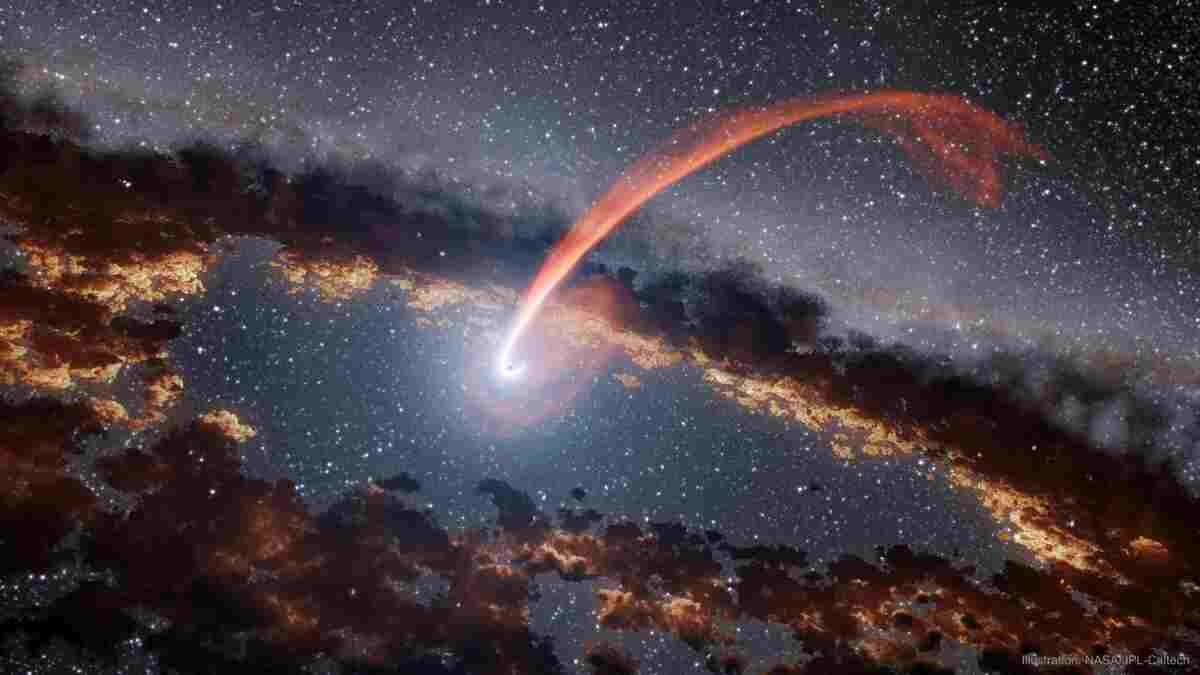

Astronomers have witnessed a rare event after NASA’s Neil Gehrels Swift Observatory tracked down a roaming supermassive black hole devouring a faraway star. The unprecedented sight will allow researchers to learn more about these catastrophic celestial bodies wandering off into the depths of space. This astronomical event is called a tidal disruption event, or TDE.
In this case, a star has come too close to a black hole, and the black hole’s near-infinitely strong gravitational pull pulls the star apart, many time referred to as “spaghettification.” The stellar gas, falling into the black hole, is then heated to millions of degrees, giving out intense sources of X-ray and ultraviolet light, and radiations of other frequencies, all detectable using space telescopes.
What is most exciting about this discovery is that this black hole seems to have passed through the center of its galaxy, rather than normally hanging out at the center of the galaxy where most supermassive black holes are.
Black holes are expected at the center of a galaxy and would naturally alter the motion of stars and gas in the galaxy. As such, finding a black hole could well have had an interesting and/or violent past with prior merging of other galaxies. The event was initially detected by the NASA Swift Observatory which observed it due to a sudden onset of high energy radiation. Swift is More exactly constructed to investigate and observe rapidly occurring high energy events in our universe. It constantly monitors the sky for sudden transient events such as the tides, supernovae and other gamma-ray bursts.
After its initial detection astronomers managed to organize follow up observations with various other space and ground telescopes. These observations provided astronomers a means to investigate how the luminosity of the star changed with time. As the material of the star spiraled into the black hole, it created a swirling accretion disk of superheated matter, which shone with an incredible brightness.
These radiation-filled environs gave scientists a unique insight into the bodies’ savage environment. This discovery also brings to the light crucial proof that supermassive black holes can be found in the outskirts of galaxies more frequently than predicted.
Scientists think that wandering black holes are the remains of past galaxy collisions, where various black holes interacted before one was thrown into another region of the galaxy. Studying these objects can help scientists understand how galaxies develop in billions of years. Since they can showcase black holes that would otherwise be hidden from our view, the study of tidal disruption events has become ever more relevant to contemporary astronomy. Unlike stars, we cannot directly observe black holes. Instead, they can only be located if they encounter mater and then feed on it.