
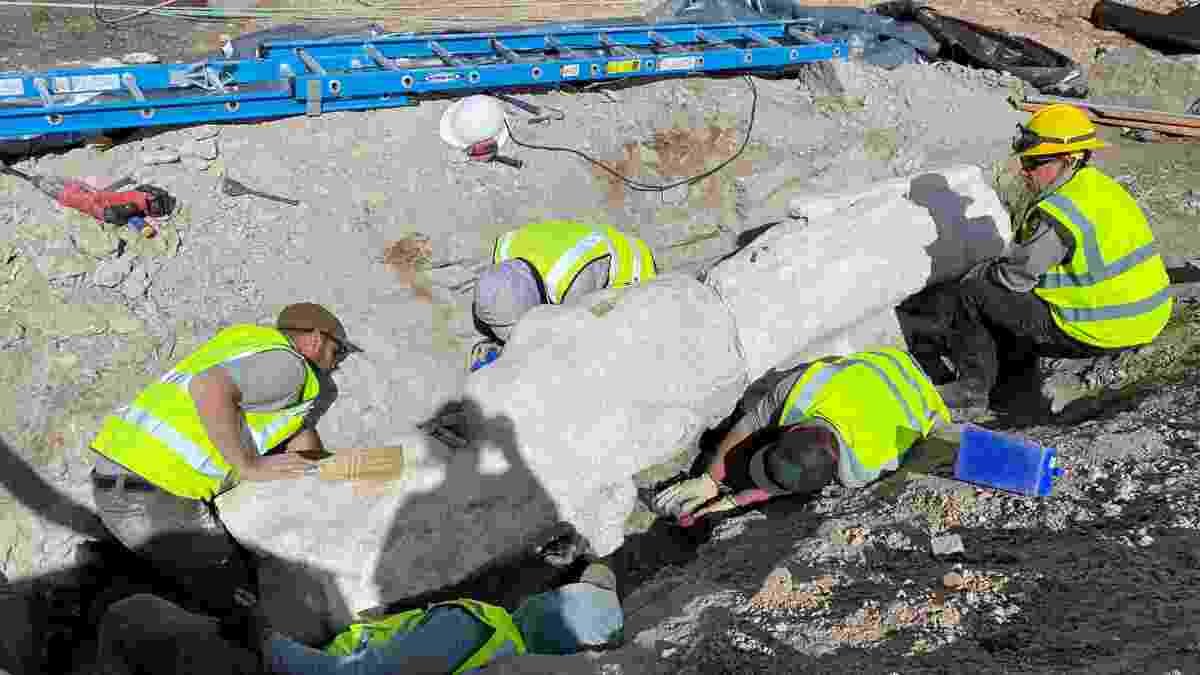

A remarkable scientific breakthrough has emerged from Dinosaur National Monument, straddling the border of Colorado and Utah, where paleontologists have uncovered significant dinosaur fossils during routine parking lot construction — marking the first excavation at this location in over 100 years.
The discovery came in September 2025 when crews were removing asphalt near the Quarry Exhibit Hall — a landmark attraction often referred to as the “Wall of Bones” due to the dense concentration of dinosaur remains encased in the rock face nearby. As workers exposed underlying dinosaur-bearing sandstone, park staff immediately identified fossilized bone fragments, and construction was paused to allow paleontologists and volunteers to begin excavation.
A Dive Into Jurassic Prehistory
The fossils found are believed to belong to a Diplodocus, a long-necked sauropod dinosaur that roamed the Earth during the Late Jurassic period around 150 million years ago. These massive herbivores could reach lengths of up to 80 feet and are known from other parts of the monument’s famed bonebeds.
Over the course of the excavation from mid-September through mid-October 2025, teams from the National Park Service (NPS), the Utah Conservation Corps, volunteers, and on-site construction crews successfully removed approximately 3,000 pounds of fossilized bone and surrounding rock. The work uncovered a range of skeletal elements — including vertebrae and limb pieces — now carefully transported for cleaning and study.
“This is the first excavation from this specific area since 1924,” paleontologists noted, pointing out that earlier digs by institutions like the Carnegie Museum, the Smithsonian National Museum of Natural History, and the University of Utah helped establish the site’s scientific heritage nearly a century ago.
From Quarry to Museum Exhibit
Following removal, the newly discovered fossils were sent to the Utah Field House of Natural History State Park Museum in Vernal, Utah, where professionals are carefully preparing and studying the remains. This preparation process, conducted in a public fossil lab, offers visitors an inside look at real-world paleontological work as scientists clean, document, and analyze the bones.
In addition to research preparation, several pieces from the excavation have already been placed on display at both the Quarry Exhibit Hall and the Utah Field House museum, enriching ongoing exhibits and educating the public about prehistoric life in North America.
A Historic Landmark Yields New Insights
The Dinosaur National Monument was established in 1915 to protect one of the most important fossil sites in the United States. The nearby Carnegie Quarry, part of the Morrison Formation rock layers, has yielded hundreds of dinosaur specimens since its discovery in the early 20th century and remains a cornerstone of paleontological research.
What makes this excavation particularly noteworthy is not just the quantity of fossils found, but the context — the location had not been actively excavated in this way for more than a century, despite being one of the world’s most famous dinosaur fossil deposits.
Experts say the site continues to be a rich window into prehistoric ecosystems, showcasing not only iconic dinosaur species like Diplodocus but also predators, plant-eating species, and other ancient life forms preserved in ancient sandstone. The new finds offer researchers a fresh opportunity to explore dinosaur biology, behavior, and the environment they inhabited.
Public Engagement and Scientific Future
Park officials stress that discoveries like this underline the importance of careful monitoring during construction and land use projects in fossil-rich regions. The public display of both historic and newly discovered fossil material at Dinosaur National Monument helps connect millions of visitors each year to Earth’s deep past.
With the parking lot and accessibility improvements now completed, and with more bones awaiting study, scientists anticipate that follow-up research in 2026 and beyond could reveal even more about the ancient ecosystems that once flourished in this now-arid region.
This discovery — blending emergency excavation, scientific precision, and public engagement — highlights how even routine projects can unearth profound insights into prehistoric life and contribute to our understanding of Earth’s evolutionary history.